Buying a belt online sounds simple until you’re staring at a size selector wondering whether “34” means your waist, your trouser size, or something else entirely. Get it wrong and you end up with a belt that’s either too tight to fasten comfortably or so long it flaps past the last hole.
This guide walks you through exactly how to measure your belt size in under a minute, using two simple methods, plus a conversion chart so you never have to guess again.
Why Belt Sizing Trips People Up
Here’s the part most guides skip: belt size is not the same as your trouser size, even though they’re closely related. A belt is measured from the point where the strap folds back into the buckle to the hole you actually use — not from tip to tip. That’s why two different methods (measuring your body vs. measuring an old belt) can feel like they give slightly different answers if you’re not doing it consistently.
The good news: once you understand what’s actually being measured, sizing a belt correctly is easy.
Method 1: Measure Your Natural Waist
This is the most accurate method if you’re buying your first belt or shopping for a gift.
What you’ll need: a flexible tape measure (a fabric one, not a metal DIY tape).
Steps:
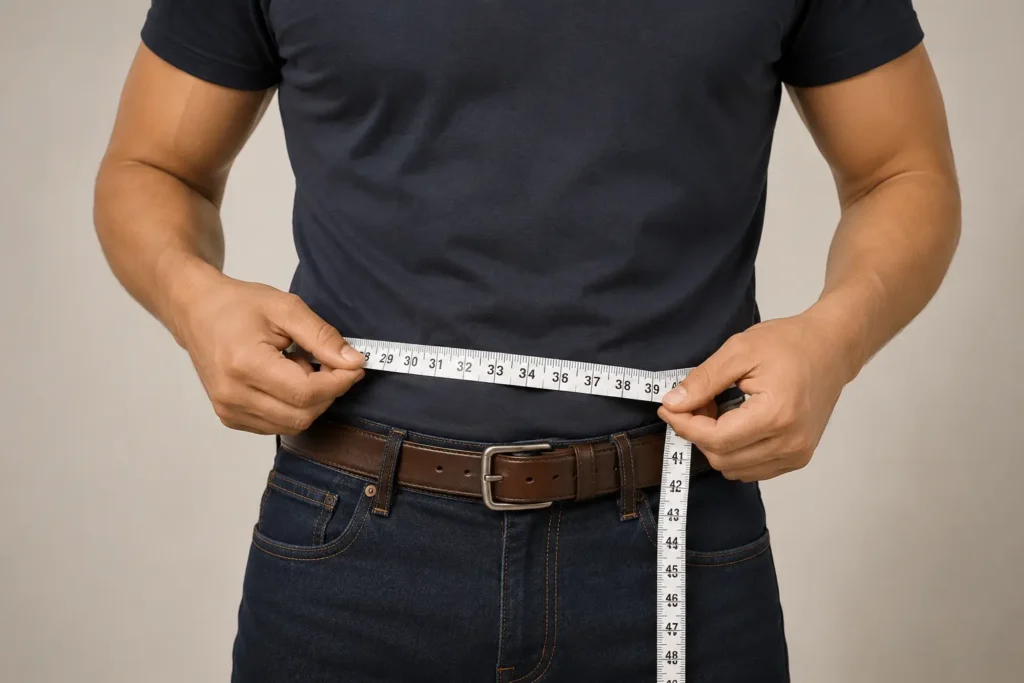
- Wrap the tape measure around your natural waistline — this is where you’d normally wear a belt, typically just above the hip bones, not where low-rise jeans sit.
- Keep the tape snug against your body, but not pulled tight.
- Read the measurement in inches (or cm, then convert).
- This number is your base waist size — you’ll use the chart below to find your actual belt size.
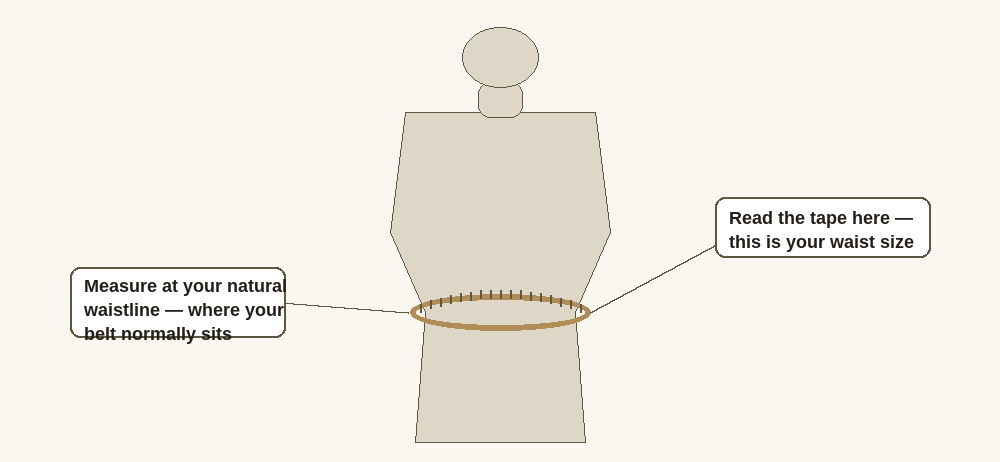
A common mistake: measuring over thick clothing (a jumper or coat) will throw off your reading by an inch or more. Measure over a t-shirt or light shirt for the most accurate result.
Method 2: Measure a Belt You Already Own and Like the Fit Of
If you’ve got a belt at home that fits you well, this is the fastest and most foolproof method — because it accounts for how you actually like to wear it (snug vs. relaxed), not just a theoretical waist number.
Steps:
- Lay the belt flat on a table.
- Find the fold point — where the strap attaches to the buckle (not the very tip of the strap, and not including the buckle itself).
- Measure from that fold point to the hole you currently use day-to-day (usually the middle hole, since a well-fitting belt should sit roughly in the middle of its hole range).
- That measurement, in inches, is your belt size.
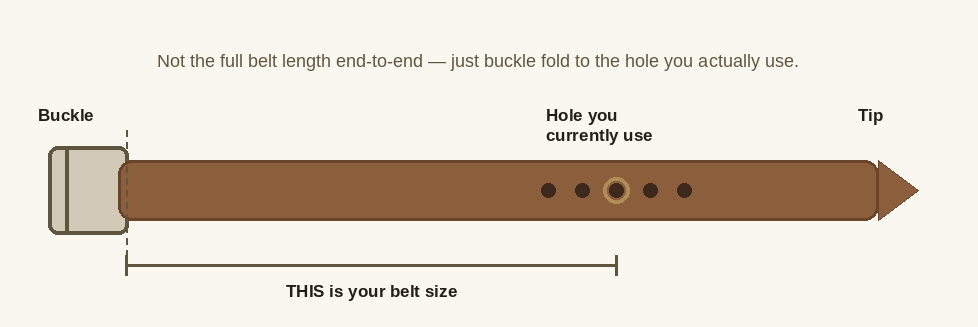
Why this method works so well: it captures your real-world preference. Some people like belts snug, others prefer a slightly looser fit — measuring an old favourite skips all the guesswork.
Belt Size Conversion Chart
If you don’t have a tape measure handy, your trouser or jean size is a reliable starting point. The general rule: order a belt size roughly 2 inches larger than your trouser waist size, since trousers are sized at the waistband itself while belts are measured to the hole you’ll actually buckle into.
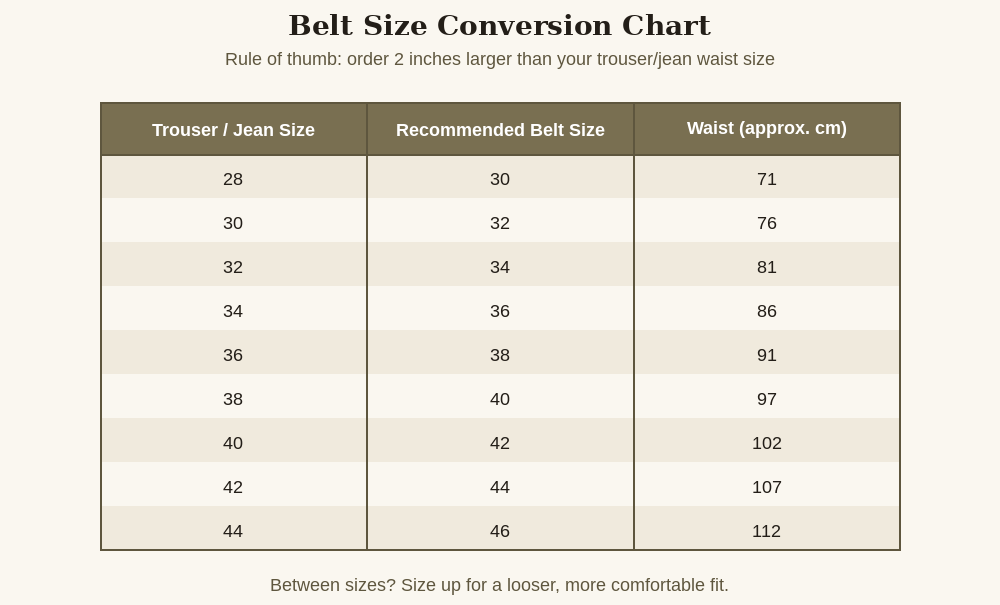
Why add 2 inches? Trouser sizing already accounts for the waistband sitting at your natural waist, but a belt needs a little extra length to comfortably reach a middle hole rather than the very last one — buckling right at the final hole gives you no room to adjust for a heavier meal or a slightly different pair of trousers.
What If You’re Between Two Sizes?
Always size up. A belt that’s slightly too long can still be worn comfortably on an inner hole — but a belt that’s too short can’t be fixed at all. If your measurement falls between 34″ and 36″, for example, go with 36″.
This matters even more with handmade leather belts, which are cut once and don’t have the stretch that cheaper synthetic belts sometimes have.
Does Belt Sizing Work the Same for Polo Belts and Kids’ Belts?
Mostly yes, with a couple of small differences worth knowing:
- Polo belts are typically woven with a longer adjustable range, so if you’re between sizes, they’re more forgiving than a fixed-hole leather belt.
- Kids polo belts should be measured the same way as Method 1 above, but re-measure every few months — children’s waist sizes change faster than adults’.
- Narrow belts follow the same sizing rules as standard belts; the narrower width doesn’t affect the length measurement.
Quick FAQ
Does belt size include the buckle?
No. Belt size is measured from the fold point where the strap meets the buckle — not from the outer edge of the buckle itself.
Is belt size the same in the UK, US, and Europe?
UK and US belt sizing both use inches and are directly comparable. European sizing is typically in centimetres — multiply your inch measurement by 2.54 to convert, or use the chart above as a rough guide.
My waist measurement falls exactly on a size — which do I choose?
Choose that size. The “size up” rule above is only for when you’re between two sizes on the chart.
Can I adjust a belt that’s slightly too big?
Yes — that’s exactly what the multiple holes are for. A slightly larger size gives you room to move a hole in or out as needed, which is why sizing up is always the safer choice.
What if I’m buying a belt as a gift and don’t know their size?
Check their trouser or jean size first — it’s usually the easiest thing to find out without asking outright (look at a pair of their jeans, or check recent online orders). Then use the conversion chart above and size up if you’re unsure. Because belts have multiple holes, a size that’s an inch or two large will still fit comfortably, whereas a size too small won’t work at all — so when buying blind, always round up rather than down.
Final Word
Measuring your belt size properly takes less than a minute and saves you the hassle of a return. If you’re still unsure after measuring, our best advice is simple: when in doubt, size up — every Qabalo leather belt is designed with enough holes to adjust comfortably either way.
Ready to find your fit? Browse the full belt collection →