
Standing in front of a belt rack — or scrolling through one online — you’ll usually land on the same fork in the road: a colourful, woven polo belt, or a classic, single-piece leather belt. They’re both leather. They’re both good belts. But they’re built differently, they wear differently, and they suit different parts of your wardrobe.
The short answer: if you want colour, character and flexibility across a range of casual outfits, go polo belt. If you want a single, understated belt that works with everything from jeans to tailored trousers and only gets better with age, go traditional leather. Most people, honestly, end up owning both. Here’s the full breakdown so you can decide what you actually need.
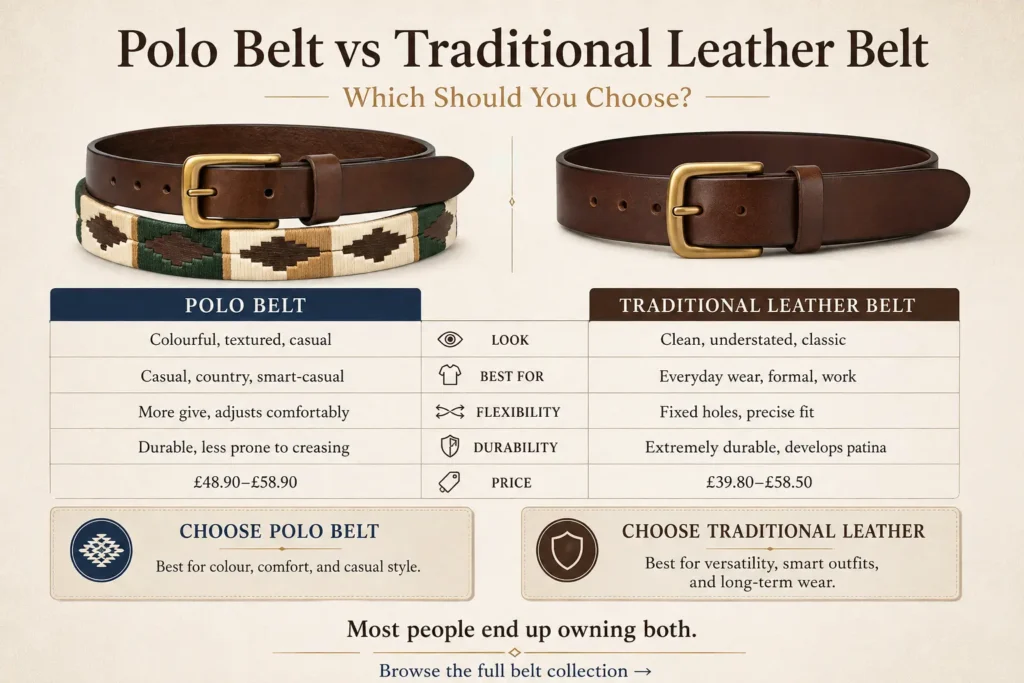
A polo belt is made from strips of leather hand-woven together, usually in two or three contrasting colours, giving it a textured, braided look. The name comes from its roots in equestrian and polo culture, where a belt needed to be tough, flexible, and easy to spot in a stable full of similar gear.
Because the strap is woven rather than cut as a single piece, polo belts tend to have a bit more give and flexibility than a solid leather strap — and the buckle is usually a simple, functional design that lets the woven pattern do the talking.
Browse our full range of polo belts to see the range of colourways available.
A traditional leather belt is cut from a single piece of leather — often bridle leather or thick full-grain hide — and finished with a solid buckle, usually brass or nickel. It’s the belt most people picture when they think “leather belt”: clean, understated, and built for longevity.
These belts are typically hand-stitched at the stress points (where the strap meets the buckle) and are designed to develop a natural patina over years of wear, rather than staying static like a synthetic alternative. Our handmade leather belt collection includes bridle leather, thick leather, and wide leather styles, each finished by hand.
| Polo Belt | Traditional Leather Belt | |
| Construction | Woven leather strips | Single-piece cut leather |
| Look | Colourful, textured, casual | Clean, understated, classic |
| Best for | Casual, country, smart-casual | Everyday wear, formal, work |
| Flexibility | More give, adjusts comfortably | Fixed holes, precise fit needed |
| Durability | Very durable, less prone to creasing | Extremely durable, develops patina |
| Formality | Casual to smart-casual only | Works casual through to formal |
| Price range | £48.90–£58.90 | £39.80–£58.50 |
You wear a lot of casual or smart-casual outfits.
Polo belts are made for chinos, jeans, and country-style clothing — they add a splash of colour and texture that a plain leather strap can’t.
You want something more forgiving on fit.
Because the weave has a bit of natural give, a polo belt tends to feel comfortable across a slightly wider range within its size, which matters if your weight fluctuates a little through the year.
You like having a few belts for different outfits.
Polo belts come in enough colourways that owning two or three feels less like a wardrobe staple and more like an accessory collection — swapping colours to match different outfits.
You’re buying for a child.
Our kids polo belts use the same woven construction, which handles the wear and tear of kids far better than a stiff single-piece belt, and adjusts more easily as they grow.
You want one belt that works with everything. A black or brown bridle leather belt goes from the office to a wedding to a Sunday lunch without ever looking out of place. It’s the belt equivalent of a good pair of jeans — quietly versatile.
You care about longevity over variety. A well-made leather belt, properly conditioned, can genuinely last decades. If you’d rather buy one excellent belt than replace a cheaper one every couple of years, this is where your money goes further.
Your dress code leans formal. Woven texture doesn’t belong in a tailored setting. If you need a belt for suits or smart trousers, a traditional leather belt — ideally narrow rather than a thick casual strap — is the correct call. Our narrow belt collection is built specifically for this.
You want the patina. Vegetable-tanned leather darkens and develops character with age and handling. If that slow transformation appeals to you, a single-piece leather belt shows it off far better than a woven one.
This is the question we get asked most, and the honest answer is: both last a long time if they’re made well — they just age differently.
A traditional leather belt develops a patina and can be re-conditioned to extend its life almost indefinitely. A polo belt’s woven construction actually distributes stress across more contact points than a single strap does, which means it resists cracking at any one point — though the dye in coloured strands can fade slightly faster than a natural tan leather belt exposed to the same sun.
Neither is the “wrong” choice on durability. It comes down to which kind of ageing you’d rather have.
Realistically, yes — and most people end up doing exactly that. A traditional leather belt for work and formal occasions, and one or two polo belts for weekends, country pursuits, and casual outfits, covers almost every situation without either one being asked to do a job it’s not suited for.
If you’re only buying one belt right now and need to pick, ask yourself: will this belt see more smart-casual weekends, or more shirts-tucked-in weekdays? That single question settles it for most people.
Whichever style you land on, sizing works the same way. Check out our full guide on how to measure your belt size before you order — it takes about a minute and saves the hassle of a return.
Generally, yes. Polo belts are best suited to casual and smart-casual settings. For formal or business wear, a narrow, single-piece leather belt is the safer choice.
The woven construction has some natural give from day one, but a well-made polo belt holds its shape over years of normal wear — it won’t keep stretching indefinitely.
Both offer excellent value at their respective price points. A traditional leather belt often works out as better long-term value if you only want to own one belt, since it covers more occasions. A polo belt offers better value if you’re building a small rotation for casual wear.
We’d steer you toward a narrow, single-piece leather belt for suits instead — the woven texture of a polo belt reads as casual, even in a subtle colourway.
Neither belt style is objectively “better” — they’re built for different parts of your week. If you want one dependable belt that goes everywhere, choose traditional leather. If you want to add colour and character to your casual wardrobe, choose a polo belt. And if you’re not sure, there’s no rule against owning one of each.
Complimentary UK delivery on qualifying orders.
Premium leather goods made with expert craftsmanship.
Straightforward returns and exchanges when needed.
Shop confidently with protected online payments.
Customer satisfaction is at the heart of Qabalo.